
Evaluating Near-Horizontal Light Emission from Outdoor Lighting
DarkSky International – Tucson, AZ
March 16, 2026
Executive Summary
Upward-emitted outdoor light has long been identified as a source of atmospheric light pollution, a.k.a. sky glow. This form of light pollution is an obvious contributor to the brightening of the nighttime sky and can be observed as glowing domes of light above urban population centers and highly industrialized areas (see Figure 0-1).

In fact, for the vast majority of urban populations on earth, light pollution is so prevalent it has significantly decreased the visibility of celestial objects in the night sky.1 For this reason, DarkSky International (“DarkSky”), a nonprofit organization representing thousands of advocates in more than 70 countries, has consistently recommended luminaire and lighting installation restrictions on upward light emissions.
However, recent concerns regarding the continued proliferation of skyward light pollution, growing by 10% annually,2 and its adverse effects upon nocturnal ecosystems1 obligate a broader evaluation of possible causes of light pollution and the development of mitigation strategies. Specifically, this white paper evaluates horizontal and near horizontal light emissions from the most prevalent types of outdoor applications, and their human usefulness versus known contributions to light pollution.
Note: The scope of this white paper is limited to the outdoor applications of highways, roadways, streets, sidewalks, parking lots, pathways, pedestrian areas, and large-area outdoor lighting applications (e.g., sports, ports, and industrial areas) utilizing pole or building mounted lighting with a mounting height of 3 meters (10 feet) or more above finished grade (AFG). DarkSky recognizes that there are other outdoor applications where horizontal and near horizontal light emission may be useful for purposes beyond the scope of this review.
As discussed further in Section 7.0 Conclusion, outdoor applications often have very specific, sometimes unique, goals and requirements for artificial light at night (ALAN). These application needs are typically designed with both objective requirements, such as electrical and energy codes, and subjective outcomes, such as visual success or emotional responses, in mind. The best way to discuss, communicate, and validate these application needs is by using a vocabulary that includes both horizontal and vertical illuminance and/or luminance values. As one might expect, the contributions and value of ALAN within these two differing planes will vary. This paper evaluates the usefulness and targeting success of commonly used luminaire emission types.
For many tasks and applications, it was found that the contribution and value of light emitted between 80 and 90 degrees above nadir is limited – and sometimes nonexistent – when compared to the visual and ecological benefits of reducing near-horizontal light pollution. As a result of this analysis, DarkSky International programs and policies now include limits on very high-angle light emitted between 80 and 90 degrees from nadir, ranging from 0% to a maximum of 5% of the total luminaire lumens.
Background
Outdoor LED luminaires emerged with great fanfare in 2008 as being ideally capable of reducing energy consumption and delivering very controlled and targeted lighting as compared to legacy light sources such as metal halide and high pressure sodium. This technological breakthrough was nothing less than transformational for the lighting industry. Governments, manufacturers, and end-users rushed to reap the benefits. Accordingly, implementation of new LED outdoor lighting soared in the decade that followed, and most outdoor luminaires installed in the U.S. today have been converted to LED.3 Unfortunately, original hopes that this technology would automatically contribute to a reduction in skyward light pollution have not materialized. Globally, the night sky is rapidly getting brighter. In North America, sky brightness increased an average of 10.4% per year between 2011 and 2022,2 and in the United States, almost 50% of the land surface area is affected by light pollution, with an estimated 90% of U.S. residents living under light-polluted conditions. For this reason, continued investigation is critically needed to understand why the night sky continues to brighten after a decade of installing highly capable LED luminaires. This paper investigates one possible contributor to light pollution: light emitted in the horizontal and near horizontal directions, which, for the purposes of this paper, is light emitted from a luminaire between 80 and 90 degrees above nadir.
Light pollution is not limited to the amount of light directed or reflected upward into the sky. It also includes unnecessary lighting, over-lighting, obtrusive sources of brightness altering lower light levels which would otherwise be effective, and ground-based light trespass traveling across property boundaries into areas where artificial light at night (ALAN) may disrupt ecosystems involving insects, plants and/or animals.45 In recognition of this, DarkSky International (DarkSky) and the Illuminating Engineering Society (IES) co-authored the Five Principles for Responsible Outdoor Lighting (see Figure 1-1) in 2020 to curb the negative effects of light pollution. The first two principles, which are intended to be the most impactful, state that any ALAN should be useful and targeted for the application. For most outdoor lighting applications the targets of illumination, including vertical surfaces rising above grade, are ground-based and/or human scale, and the lighting is provided for the purpose of safe and comfortable pedestrian activity (e.g., streets, sidewalks, parking lots). Accordingly, lighting for these applications should be properly targeted and useful to the intended function. Unnecessary and/or untargeted (i.e., stray) light should be avoided to prevent wasted light that adds to light pollution.
The human usefulness of horizontal or near-horizontal light emission from outdoor luminaires is the subject of this paper.

Problem Statement
In an effort to reduce the most obvious atmospheric light pollution, many organizations and lighting professionals support initiatives restricting direct luminaire uplight (defined as light emitted above a horizontal plane located 90 degrees from nadir and passing through the lowest light-emitting part of the luminaire). The ANSI/IES Back light, Uplight, and Glare (BUG) ratings and the Upward Light Ratio (ULR), as defined by the International Commission on Illumination (CIE), are two examples of how a lighting professional might evaluate luminaire appropriateness. However, with a goal to understand all light pollution (i.e., wasted and unwanted light with no benefit or purpose), DarkSky is interested in reducing not only the atmospheric form of light pollution, but also any other concerning forms of light pollution, including excessive and inappropriate over-lighting, property trespass, and obtrusive glare, all of which can negatively affect the nighttime experience and diminish visual comprehension at night.
For example, even if lighting professionals have the best intentions to limit direct emissions of uplight, horizontal (i.e., at 90 degrees above nadir) and near horizontal directed light can be just as problematic to the atmosphere if the luminaire has an uninterrupted line-of-sight to the horizon. (See Figure 2-1 for an example.)
For this reason, it should be noted that luminaires sold with no known upwardly directed light can still contribute to atmospheric sky glow.

For context as to why this is important, scientific studies indicate that light emitted horizontally and upward within 4 degrees of horizontal (i.e., 90 to 94 degrees above nadir) generates sky glow spectrometer readings 50 to 100 times higher than that emitted at zenith (i.e., straight upward).1 Other research supports this concept by showing how light pollution aimed straight upward may be 15% scattered, while light emitted horizontally and upward 10 degrees (i.e., 90 to 100 degrees above nadir) will be nearly 100% scattered before leaving the atmosphere (see Figure 2-2).6 As the observer distance from an urban city grows, the 90- to 100-degree emission zone becomes increasingly consequential to sky glow.78


These conditions of tolerance and variability can be additive when using lighter weight LED retrofit luminaires in place of original and heavier HID legacy luminaires because the weight of the luminaire will not re-establish a counterweight to balance the pitch of a mast arm or light pole.9 Exacerbating the quantity and angularity of light emissions in the horizontal and near horizontal directions are luminaires intentionally articulated and/or tilted during installation to extend light outward toward property boundaries.1 Here again, light that was intended to be distributed below 90 degrees is now becoming a source of unwanted light pollution in the horizontal and/or upward directions. With this in mind …
DarkSky believes it is prudent to evaluate different outdoor applications and the usefulness of light emitted in the horizontal and near horizontal angles (80 to 90 degrees) to ascertain the different benefits, tradeoffs, and/or mitigation techniques which could contribute to less light pollution and improved visual safety at night.
Outdoor nighttime applications discussed within this white paper (and the associated ANSI/IES Recommended Practices) include:
- Roadway and parking (RP-8)10
- Pedestrian and public spaces (RP-43)5
- Sports and recreational areas (RP-6)11
- Industrial facilities (RP-7)12
- Port terminals (RP-40)13
Beneficial uses of appropriate outdoor lighting include:
- Horizontal illumination at ground level to avoid tripping hazards
- Vertical illumination of surroundings for the benefit of landmark identification and wayfinding
- Vertical illumination for the benefit of threat assessment
- A pleasing and comfortable aesthetic that helps to identify patterns, define outdoor space, and provide wayfinding information for the user
Benefits of mitigating horizontal and near horizontal light emission may include:
- Improved nighttime visual performance if, and when, glare is reduced
- Reduced light pollution from uninterrupted 90-degree and near horizontal light
- Reduced light pollution from installation variance and tolerance
- Reduced light trespass, which has an environmental impact on wildlife living below luminaire height
- Financial savings by eliminating light that is not useful
Evaluation Methodology
This paper will utilize the concepts presented in ANSI/IES TM-15-20, Technical Memorandum: Luminaire Classification System (LCS) for Outdoor Luminaires14 to describe distribution of light emitted from an outdoor luminaire. The LCS consists of 10 predefined solid angles in the forward, backward, and upward regions of a luminaire’s potential light emission as shown in Figure 3-1.

Light emissions in the upward direction (a combination of the UL and UH zones comprising all angles above 90 degrees, or the U rating in the BUG system of ANSI/IES TM-15-2014) are used to rank the risk of atmospheric light pollution caused by a luminaire. The terms U0, full cutoff, and fully shielded are all widely used within policy and code to identify luminaires that emit no light above 90 degrees. While these terms technically describe different things, they remain popular today and are found in building codes, energy standards, state statutes, and municipal ordinance language across the United States. In an attempt to be clear and avoid decremented definitions, DarkSky uses a more understandable term called zero uplight.
A less-examined source of light pollution is the horizontal and near horizontal light emissions from outdoor luminaires defined in the LCS as very high zonal emissions. The very high secondary forward and backward zones known as FVH and BVH, respectively, are shown in Figure 3-1. This paper evaluates whether light emitted within the FVH and BVH zones serve a useful function in outdoor applications or have negative consequences with respect to light pollution and/or visual performance.
The LCS provides a convenient system for this evaluation, as shown in Figure 3-2. The percentage of light output in the two VH zones is easily identified for a given luminaire from standard photometric testing. An example of individual luminaire results, shown in Figure 3-2, indicates the percentage of total luminaire lumens emitted in the FVH and BVH zones. In this example, the highest VH total is 1.3% in the FVH zone, with a total VH percentage of 1.8% for both FVH and BVH zones combined. This paper will henceforth refer to “VH” lighting, meaning light emitted from the FVH and BVH zones combined.

Mathematical Modeling
4.1 Horizontal Illuminance
Often used to design, discuss, and measure illumination in outdoor spaces, horizontal illuminance can help identify the ability of people to walk, run, and navigate terrain while identifying possible hazards. Horizontal illuminance can also provide the opportunity to relax, read, dine, and see other horizontal surfaces that are not at grade or terrain. The utility of light emitted within the VH zones and its ability to create horizontal illumination on the ground plane is described in Figure 4-1, using an emission angle of 80 degrees as the example. Given that outdoor lighting is generally devoid of interreflections, simple inverse-square principles apply (see Equation 4-1). It should be noted that everything can be defined by the luminous intensity, the angle of emission, and the mounting height (H) of the luminaire.
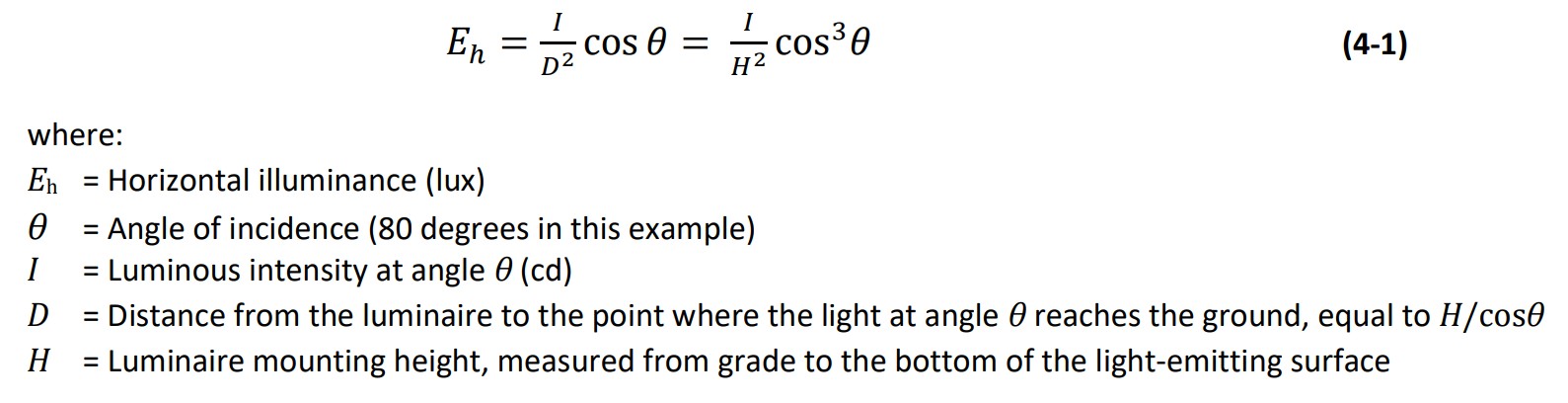

Using the formula from Figure 4-1, light emissions from an 80-degree angle will intersect the ground plane at a distance of 5.67H away from the luminaire mounting position. The resulting horizontal illuminance at this distance will be equal to the luminous intensity (candelas) multiplied by 0.005236/(H2).
Assuming a mounting height (H) of 1 unit (e.g., meter, foot) and a uniform candlepower distribution (I) of one candela, Figure 4-2 displays the values and mathematical relationship between horizontal illuminance and emission angle between nadir (0 degrees) and 89 degrees. As shown in the graph, the horizontal illuminance values decline as the angle of light emission increases. Specifically, the resulting horizontal illuminance on the ground plane from light emitted in the VH zones becomes extremely inefficient for emission angles above 80 degrees and almost nonexistent above 85 degrees.

Given that luminous intensity in the real world can vary by luminaire selection and emission angle (e.g., the light distributions and patterns described in ANSI/IES RP-8-259), Figure 4-2 or Equation 4-1 can be used to evaluate the efficiency of high-angle emission for a resulting horizontal illuminance. For example, using a luminaire mounting height of 4 meters AFG (pole or wall mount) and the VH median angle of 85 degrees, horizontal illuminance on the ground is 0.044 lux per 1,000 cd. Is that good? How can the tradeoff between the prescribed horizontal illuminance value and the mathematical brightness needed to achieve the illuminance be evaluated?
Aside from sports and industrial lighting, which may require higher light levels,1112 most urban and suburban environments utilize ALAN to create environments where pedestrians are visually adapted to high-mesopic or low-photopic lighting conditions.5 These conditions are typically found when light sources generate between 1 and 40 lux of illumination.5 The goal of nighttime outdoor lighting is to create a luminance contrast or chromatic contrast among the objects and/or features within the field of view, allowing people to perceive their surroundings.15
The amount of light allowed to enter the eye will be determined by the adapted pupil size, the luminance of the object being viewed, and the distance between them.15 Allowing the right amount of light into the eye is key for visual needs within the outdoor nighttime environment.16 Research on this topic shows that typical nighttime detection and recognition tasks, as opposed to foveal discrimination (e.g., reading a book), are aided by adrenaline induced pupillary arousal (i.e., larger pupil size) capable of interpreting faint contrasts in unpredictable parts of our peripheral vision – thereby making larger pupils more effective for nighttime vision because they increase the overall light influx, which enhances the human ability to detect and recognize objects and/or features against a nighttime background.16 However, when an excessively bright light source enters the field of view, this can cause the pupils to shrink, which is a protective reflex to prevent retinal damage, and in turn causes a loss in perception of the visual scene. This photophobic response is also known as glare, which may cause a reduction in visual performance (i.e., disability glare) or generate a feeling of discomfort (discomfort glare).
For example, using a parking-lot application where a minimum horizontal illuminance of 2 lux is recommended for visual performance and two separate luminaires will contribute to the illumination, each luminaire could contribute 1 lux of horizontal illuminance. If the midway point between the two contributing luminaires required an emission angle of 85 degrees from a luminaire mounted at 4 meters AFG, the luminaire would need a luminous intensity of approximately 23,000 cd at that angle. This would be an objectionably high source of visual brightness (e.g., brighter than car headlights), causing glare and potentially reducing visibility – and thus counteracting any benefit of adding 1 lux of horizontal illuminance onto a user area adapted for lower light levels. Therefore, VH light emission has questionable use for horizontal illumination when located at a significant distance from the light source. (See Section 5 and its subsections for more information on typical pole spacing.)
This example illustrates two additional concerns with VH zone light emission. First, not only does the light fail to provide adequate and useful horizontal illumination for pupils adapted to an excessively bright source, but it may have unnecessarily consumed valuable energy to do so. (See Section 6.2 Energy for more detail.) Second, VH-zone light emission may travel hundreds of meters before reaching the ground plane1 and, if uninterrupted or reflected, will add to light pollution that may disrupt wildlife, habitat, and ecosystems beyond the intended illumination target. For example, the light emitted at 85 degrees above nadir from a luminaire with a mounting height of 10 m (33 ft) would reach the ground 114 m meters (375 ft) from the pole base. This example is especially concerning for an application located in elevated topography, desert, or an open plain area, where there is nothing to stop the light from traveling great distances through the atmosphere (see Figure 2-1, Section 2.0). As described in Section 2.0 Problem Statement, even the slightest amount of tilting or installation inaccuracy can exacerbate the problem, and when luminaires are taller, they are generally emitting substantially more light, and thus contributing to the light pollution problem even further.
4.2 Horizontal Illuminance – Continuous Lighting
A long-standing principle within the lighting industry is that uniformity, or evenness, of horizontal illumination on the ground, street, or sidewalk is good for visibility. It is frequently claimed that the human eye cannot simultaneously accommodate very dim and very bright light sources. To avoid a “striated lighting effect” (i.e., alternating bright and dark patches), many industry recommendations use continuous lighting and limit max:min illuminance ratios to no more than 10:1. However, research has shown that the human eye can accommodate max:min ratios of 100:1 and that contrast can improve visual performance under certain conditions, such as roadway lighting.17
As discussed in Section 4.1 and shown in Figure 4-2, the horizontal illuminance benefit and utility of light emitted from a single luminaire between 80 and 90 degrees ranges from marginal to nonexistent. However, one observation is that the light emitted at 80 degrees, although inefficient, may be marginally valuable because of its ability to enable maximum pole spacing, potentially resulting in lower infrastructure cost and investment. For the sake of debate, one could make the argument that 75 degrees is a better threshold than 80 degrees for producing efficient horizontal illuminance when compared to the amount of candlepower required. However, in situations of continuous lighting, the midway zone between successive luminaires will actually receive horizontal illuminance contribution from two (or more) luminaires. This “stacking” of illumination contribution may boost the value of light emitted at 80 degrees in “wide” distribution types because pole spacings can be maximized. However, individual cases need to be analyzed with some caution and reviewed against uniformity conformance recommendations. For example, a “medium” distribution yields a midway point between infrastructure (e.g., poles) very near a 75-degree emission angle, as shown in Figure 4-3, when using a spacing-to-mounting-height ratio of 7. (Note that there is virtually no illumination stacking from light emitted from the two luminaires above the 79-degree emission angle.)

4.3 Vertical Illuminance
Less often used in the discussion of outdoor lighting, vertical illuminance may be very beneficial for meeting personal needs. Vertical illumination in the outdoor nighttime environment helps people understand horizon, backgrounds, and the movement of other people and/or objects by creating contrast and silhouette. For sport and recreational lighting, vertical illuminance is a key ingredient for safe play. Generally speaking, vertical illumination may be beneficial by making landmarks, moving objects, other threats, and points of egress visible for pedestrians, and by making those very same pedestrians visible to drivers of vehicles. Light emission within the VH zones may contribute to vertical illumination if it hits a target.
Of note, creating nighttime contrasts and silhouettes using architectural backgrounds may not require vertical illumination to be generated from pole-mounted luminaires. There are many other lighting options for wall washing, grazing, and facade illumination that can be installed closer to the target and provide the desired illumination with far greater efficiency.
A quick analysis of pole-mounted lighting for the purpose of vertical illumination leads to a conundrum without a good solution. As suggested in Section 4.1, it is possible for the luminous intensity of luminaires to cause glare and reduce visibility for people who are walking, playing or working nearby at night, thus counteracting any benefit of identifying other people or moving objects.16 For pedestrian activity, it is often believed that facial expressions contribute to threat assessment and reassurance. However, given a quick ability for pedestrians to move left or right, redirect, and swivel in any of 360 degrees, the amount of illumination necessary for actual facial recognition would be extraordinarily high.18 Additionally, research shows it is difficult to increase the luminous intensity directed toward people’s faces without that same source creating glare and visual disability for the target or observer; one person’s visual benefit can become another person’s visual disability. ANSI/IES RP-43-25, Recommended Practice: Lighting Exterior Applications5 summarizes this condition as follows: “For this reason, expense and over-lighting are serious concerns with respect to making facial details recognizable at distance. In fact, the additional illumination could actually present itself as glare and become counterproductive, preventing facial recognition.”
For context, pedestrian vision at night may require lighting conditions different from those required for driving a motor vehicle. Research identifying an optimum illuminance for understanding the emotional intent of approaching pedestrians via facial recognition is just beginning. Observer age, skin tones, and interpersonal distance all play a factor in the results.15 However, there are additional clues such as behavior, gender, body type, posture, and group size that provide valuable threat assessment information5 and that require far less illumination. As a result, rather than mandating a vertical illuminance light level, it is more practical to identify an efficient and usable angle of light emission that can provide the necessary illuminance at the distances required for pedestrian threat assessment and decision-making, 10 to 15 meters (33 to 49 feet). (For more details, see Section 5.1.2 Pedestrian Lighting.)
For horizontal illuminance, the example used in Figure 4-2 was easily scalable, and units were used for simple multiplication for the reader to use. For vertical illuminance, however, the assumed target heights for a face are fixed, and the resulting geometry varies as luminaire mounting height increases above head height. Figure 4-4 assumes a target face height of 1.8 meters (6 feet) and luminaire heights of 3.7 meters (12 feet), representative of pedestrian pathway lighting. As a result of this geometric relationship, the table shows that for every 1,000 cd (an acceptable luminous intensity for nighttime conditions19) between 80.0 and 82.7 degrees above nadir, the vertical illuminances at 1.8 meters (6 ft) AFG are 8.2 lux and 4.4 lux (low photopic conditions) at 10.8 meters (35 feet) and 15 meters (49 feet) away from the luminaire, respectively. (These are the distances identified by research where pedestrian threat assessment is made.)

Using the inverse-square law, the formula for vertical illuminance is:
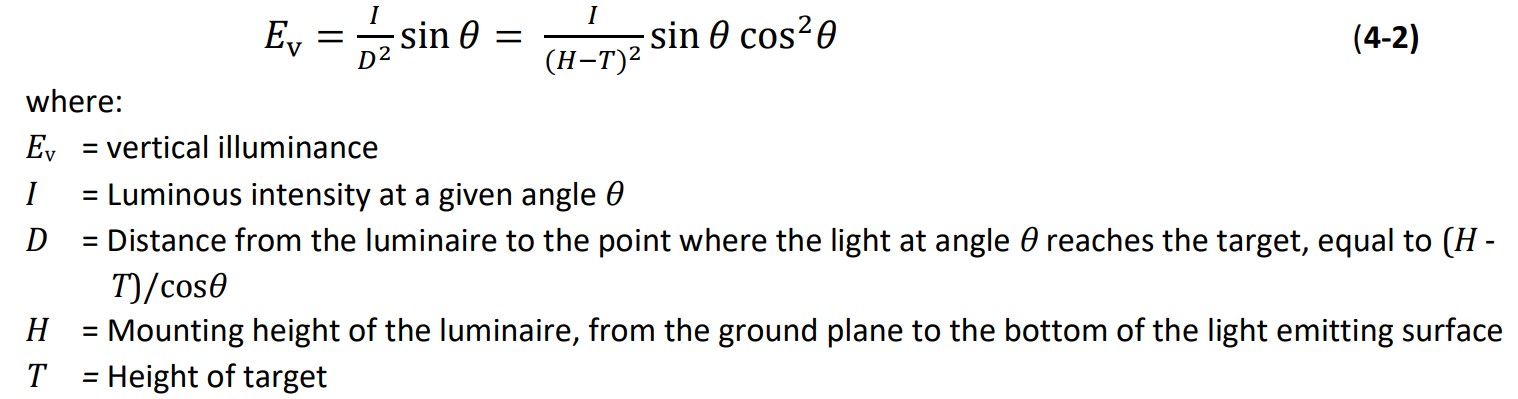
In summary, acceptable luminous intensity emitted at 82 degrees from nadir is capable of achieving vertical illuminances often recommended by ANSI/IES standards for pedestrian applications, and at the prescribed distances to support pedestrian threat assessment. Meanwhile, emission at 85 degrees generates a light level less often recommended for vertical illuminance (2 lux), and at a distance double what is needed for threat assessment (21.7 meters, or 70 ft), making 85-degree light emission far less efficient or useful for this application.
4.4 Combined Analysis
The examples in Figures 4-2, 4-3, and 4-4 (see Sections 4.2, 4.3, and 4.4, respectively) are illustrative and performed on a per-1,000-candelas basis, assuming an equal candela distribution, which is theoretical and for example only.
The distribution for a real luminaire is shown in Figure 4-5, illustrating the horizontal and vertical illuminances resulting from a luminaire with a Type III Medium distribution mounted at 3.7 meters AFG in the pedestrian lighting application used in Section 5.2. What is evident is the negligible purpose, value, or contribution of light emitted between 80 and 90 degrees for horizontal or vertical illumination toward an intended application or task. However, if significant amounts of light emission within this range exist, then it may result in obtrusive light, light trespass, and/or sky glow, (i.e., the very definitions of light pollution).

For pole-mounted outdoor luminaires, photometric distributions are classified in ANSI/IES RP-8-25 using multiple mounting heights at which the maximum candela values are directed.10 For example, a Type III Medium distribution roadway luminaire could have its maximum candlepower value at 78 degrees above nadir when pushed to the outer limit of its defined range (2.75MH Longitudinal Roadway Line, 3.75MH Transverse Roadway Line). Luminaire manufacturers choosing to locate the peak candlepower at a higher angle above nadir can theoretically boost the horizontal and vertical illuminance at greater distances away from the luminaire, but as demonstrated in these examples, when the emission is at vertical angles greater than 80 degrees, the incremental increases in illumination may not be useful and are likely to generate obtrusive light, light trespass, and potentially visually disabling conditions. Traditionally, there has been a desire to increase the vertical angle of peak candlepower in order to increase pole spacing and thereby reduce the quantity and frequency of luminaires and poles, resulting in lower costs and less clutter.
As a result, very high-angle light emission plays a significant role in lighting design solutions for outdoor applications. Designers must evaluate the value of vertical illuminance generated by 80- to 90-degree emission: to what extent does the very high-angle illumination contribute to its intended function, what is the negative perception of the higher angle brightness, are there energy costs associated with unnecessary light, and will more poles in the ground be required to meet the illumination standards?
Application Modeling
5.1 Luminaire Spacing and Performance Evaluation
Important: ANSI/IES recommendations regarding illuminance and uniformity are intended to guide proper lighting design decisions. Additional considerations regarding application, lighting zones, adaptation (see Section 5.2 Visual Performance), luminaire selection, and luminaire positioning will influence lighting design decisions. Calculations may then be used to validate the design and/or demonstrate compliance to standards.
Leveraging the first two recommendations of the DarkSky and IES Five Principles for Responsible Outdoor Lighting – 1) assessing whether the light is useful, and 2) targeting the light toward where it is needed – the following two subsections provide an analysis of luminaire placement, investigating whether light emissions in the VH zones provide purposeful lighting under two typical outdoor lighting applications, roadway lighting (Section 5.1) and pedestrian walkway lighting (Section 5.2). In these two instances, artificial illumination at night is measured against two basic design criteria: horizontal luminance and/or illuminance on the ground plane, and vertical illuminance on pedestrians and/or objects within crosswalks and the surrounding area to conduct safety and threat assessments, respectively.
5.1.1 Roadway Lighting
With safety at the core, the purpose of roadway lighting is to enhance the visual performance of people in the nighttime environment.10 This visual assistance is intended to warn people of what lies ahead and thus provide an opportunity to mitigate potential conflicts and/or collisions, whether between vehicles, pedestrians, or both.
The ANSI/IES RP-8-25, Recommended Practice: Lighting Roadway and Parking Facilities standard10 provides luminance, illuminance, and uniformity recommendations for roadway lighting depending on the road classification, the level of pedestrian conflict, and the surrounding background. For these applications, adherence to recommendations requires thoughtful decisions regarding luminaire distribution pattern, mounting locations, mounting heights, tree obstructions, and how to maximize lighting efficiency using the least amount of lighting equipment necessary. With consideration for all these factors, a general rule and historical guideline suggests roadway luminaires can typically be spaced at five to seven times the mounting height (MH) for continuous lighting and still achieve luminance and uniformity recommendations. Of note, luminaire positioning is often established in increments of 9 m (30 ft) to coordinate with city block and tree spacing dimensions.
Using the discussion from Section 4.0 Mathematical Modeling, Figure 5-1 demonstrates how luminaires spaced at five to seven times MH can provide useful horizontal light with traditional luminaire (or pole) spacings using only the light emitted below 80 degrees from nadir. For example, light emitted at 80 degrees from a luminaire with MH of 9.1 m (30 ft) AFG can travel 51.8 m (170 ft) in one longitudinal direction (for continuous lighting, pole spacing would be twice that). This distance is well within the range for meeting luminance and uniformity ratios (e.g., 3:1 to 10:1) with typical continuous pole spacings of 45.7 m (150 ft) to 64 m (210 ft).

Another important consideration for roadway lighting is wasted light and light trespass. As an alternative to using a series of shields to block light that was already generated, which is an inefficient use of energy, Figure 5-1 considers the minimization of light emission above 80 degrees from nadir. As shown, light emitted below 80 degrees is capable of longitudinal illumination supporting typical roadway luminaire spacings of five- to seven times pole height. This is not to say roadway luminaire products must be completely devoid of light emissions above 80 degrees, but the usefulness is not apparent. It seems prudent to recognize that in some luminaires the peak candlepower angles occur above 70 degrees from nadir. An informal evaluation of street lighting luminaires under conditions matching those shown in Figure 5-1 indicated that up to 3% of the luminaires’ total light emission may occur above 80 degrees.
Figure 5-1 notwithstanding, actual luminaire selection and photometric analysis are needed to see if recommended luminance values within the ANSI/IES RP-8-2510 standard can be met. Figure 5-2 shows an example for continuous lighting on a six-lane arterial roadway with a 35-meter (11 ft) median, adjacent bike lanes, and adjacent pedestrian sidewalks. The chosen 135-watt Type II luminaire emits 13,295 lumens and has a BUG rating of B1-U0-G2. The FVH and BVH emission levels are 160 and 11 lumens, respectively (a combined 1.23% of total lumen output). The luminaires are mounted at 9.1 m (30 ft) AFG and spaced 61 m (200 ft) apart. They have a total LLF = 0.81. The results of this lighting design meet ANSI/IES recommendations for the roadway, bike lane vertical, midblock crosswalk, sidewalk horizontal, light trespass, and sidewalk verticals aimed along the road, both with and against the flow of traffic. (See Annex A for details.)

5.1.2 Pedestrian Lighting
The most demanding criteria for pedestrian lighting are for those applications needing increased priority for interpersonal evaluation and assessment. Per ANSI/IES RP-43-255: “‘[O]ther people’ can be a primary threat to pedestrian reassurance. … When encountering other people in a public space, it is essential to have the ability to assess threatening appearances or behaviors early, in order to have more decision time to approach or avoid.”It is important to remember that “other people” can mean anyone, and the light needed to illuminate someone’s face may be the same light that could visually impair the observer, thus preventing a pedestrian from seeing others. This becomes increasingly problematic with lower mounting heights.
The time available for useful and reliable facial appraisal is very small. Gaze duration and observation distance for this task play a key role in the illumination recommendations. An analysis of pedestrians’ gaze behavior suggests a tendency to look toward other people for very brief glances at a distance of about 10 to 15 meters (33 to 49 ft).20 This is particularly important when using pedestrian scale luminaires, which have lower mounting heights than roadway luminaires and therefore a more challenging geometry for achieving vertical illumination at distance. As shown in Figure 5-3, light emitted below 80 degrees is capable of longitudinal illumination supporting gaze behavior aimed at a task height of 1.8 m (6 ft) AFG when located halfway between typical luminaire spacings of 15 to 28 meters (50 to 90 feet).

Luminaire selection and photometric analysis for the pedestrian component of recommended illuminance values within ANSI/IES RP-8-2510 are shown in Figure 5-4. This example is for continuous lighting on a two-lane local roadway with adjacent bike lanes and adjacent pedestrian sidewalks. The chosen 37-watt Type-II luminaire emits 3,641 lumens and has a BUG rating of B1-U0-G1. The FVH and BVH emission levels are 10 and 6 lumens respectively (a combined 0.43% of total lumen output). The luminaires are mounted 3.7 m (12 ft) AFG on poles spaced 24.4 m (80 ft) apart. The luminaires’ total LLF = 0.81. The results meet IES recommendations for the roadway, bike lane vertical, midblock crosswalk, sidewalk horizontal, light trespass, and sidewalk verticals aimed along the road, both with and against the flow of traffic. (See Annex B for details.)

5.1.3 Industrial Spaces and Port Terminals
A recent case study in the United States led by the “Dark for the Park Alliance” (which includes Carlsbad Caverns National Park, Chaco Canyon National Historic Park, the Bureau of Land Management, New Mexico State Lands Office, New Mexico Oil and Gas Association, and DarkSky International) observed a 99% reduction in sky glow and 60% energy savings from one Permian Basin industrial installation that was renovated using luminaires with no more than 3% of the total luminaire output emitted above 80 degrees from nadir. (See Figure 0-1 in the Executive Summary and Figure 2-1 in Section 2.0 for pre-installation conditions.)
In another recent U.S. project at the marine port terminal of Tampa Bay, Florida, designs completed by port engineers and DarkSky, in compliance with OSHA lighting regulations, contained 90% of all lumens within the work site, with strict limits on light trespass into the water and neighboring habitat. With poles that are 30 m (100 ft) tall, the design solution did not have any useful purpose for light emission above 80 degrees from nadir.
These prototype projects are testaments to the value of targeted lighting that is contained to the area with limited VH lighting emissions. In both cases, the lighting designs delivered the required illumination levels and uniformity, while eliminating wasted uplight and reducing light trespass by minimizing VH light emissions.
5.2 Light Trespass
As shown in Annex A and Annex B, maximum light trespass values of 1 lux were achieved for both a six-lane arterial application (see Section 5.1.1) and a two-lane local roadway application (see Section 5.1.2). The 1-lux threshold, from ANSI/IES RP-8-25, Recommended Practice: Lighting Roadway and Parking Facilities,10 assumes Lighting Zone 1 (Lz1) criteria, which would be very appropriate for a two-lane local roadway application and one of the tougher criteria for a six-lane arterial roadway setting. It is important to understand this type of detail and the boundaries of optical performance because tougher light trespass restrictions may become mandatory in areas of environmental sensitivity.
For example, two real-world highway interchanges in California were selected by the California Department of Transportation for analysis of their effect on terrestrial wildlife.21 An AGi32 simulation revealed that light trespass into a nocturnal habitat from the State Route 12/State Route 113 roundabout intersection and the Route 79/Gilman Springs Road interchange on/off ramp could be reduced by 25% to 30% while still meeting the roadway lighting standards if the luminaires were shielded in the 80- to 90-degree VH zones (see Figure 5-5).


Other Considerations
6.1 Visual Performance
As documented in ANSI/IES RP-43-25, Recommended Practice: Lighting Exterior Applications,5 when moving from a brightly illuminated area to a dark one, the eye takes time to become dark-adapted so that low-contrast details can be seen. A combination of pupil size change, neural shifts, and photochemical changes takes place. In fact, adaptation effects may have performance and safety implications. Research suggests that visual detection performance is reduced when a bright light source is visible against the dark surround, causing a change in adaptation state.5 Such a change in adaptation level may cause a transitional loss of visual acuity where landmarks and other built environment elements that are used to facilitate orientation may become less visible to the pedestrian.
Although a standardized system for measuring outdoor glare does not yet exist, it is evident that VH luminaire emissions may contribute to light received within the visual field of view. Light emitted directly from the luminaire sources discussed in this white paper will reach an observer’s eye between 1 and 10 degrees above the primary gaze, depending on mounting heights, distance, and grade. This range for potential brightness is well within the normal field of view (i.e., parafovea, perifovea, and near peripheral) for a typical motorist and/or pedestrian22 who is attempting to detect and recognize obstacles162324 (see Figure 6-1). Any reduction of luminous intensity within this VH range may help reduce glare, maintain nighttime adaptation levels, and facilitate larger pupils.

While light emission within the VH zones are currently part of the Glare rating definitions of Annex A from ANSI/IES TM-15-20,14many lighting professionals understand that the situational positioning of luminaires is missing, and therefore this metric might not be a good indicator of glare. For example, if a luminaire has some very high-angle light emission, but the background surround is also bright or if the light emission never reaches the eye of the observer, then it might not be a source of glare.
However, there is a root idea embedded within the ANSI/IES Glare rating, that very high-angle brightness against a dark or nighttime background can enter the eye, alter adaptation, and be perceived as glare. For example, to prevent distracting and uncomfortable glare, ANSI/IES RP-8-2510 recommends that luminaire emissions be limited within the visual field of view between four degrees (i.e., just above primary gaze) and upward to fifteen degrees for parking garages with low ceilings (see Figure 6-2). Using the geometry of alternate interior angles, this guidance equates to limiting the amount of luminaire emission between 75 and 86 degrees above nadir. This means that, depending on the outdoor application and the situational nighttime surroundings, it would be prudent to understand whether the VH light emissions are useful. If they are not useful, then light emissions within this zone may be wasteful and only make visual performance at night more difficult.

6.2 Energy
Research conducted in 2016 estimated that 2.5% of United States electricity production is expended on outdoor lighting, about 30% of which is wasted upward into the night sky.25 The U.S. Energy Information Administration estimates the 2022 cost for electricity was $482 billion.26 That means the amount of energy consumed in skyward light pollution is a significant financial investment that could represent $3.6 billion of savings each year. As discussed earlier in this paper, there may be outdoor applications where some very high-angle light emission is useful. However, when 80- to 90-degree VH light emissions are shown to be of insignificant human utility, reducing emissions in the VH zone could prevent unnecessary energy consumption.
Accordingly, incentive programs currently exist that promote and reward the use of highly efficacious luminaires. As intended, the goal of energy savings is noble and financially rewarding. However, what if some of that energy is used to create light emission is not needed or useful? Does that product, in fact, not become less efficient than previously assumed? For example, if a luminaire emits 100 lumens per watt of power, it may be viewed as a good purchase and one that will help save wasted energy. But what if 15% of its light emission is above 80 degrees and not useful? That luminaire is now producing only 85 useful lumens per watt. In other words, total luminaire lumens are not necessarily the “net usable lumens” delivered to the task area. Unfortunately, factors like this are not generally considered, and energy efficiency has traditionally been focused on overall light output without regard to how much of that lighting is useful. In this regard, DarkSky believes that better metrics for useful light in outdoor lighting environments are required.
Conclusion
With consideration for many common outdoor applications, the function and existence of artificial light at night (ALAN) remains human centric. The Five Principles for Responsible Outdoor Lighting cite usefulness and targeted illuminance as primary objectives when using ALAN. For the benefit of people at night, the fundamental needs of spatial understanding, navigation, threat assessment, reassurance, and hazard detection are critical.121517 Horizontal and vertical illumination are the most commonly used metrics by which this usefulness is evaluated.
Based on mathematical ray-tracing calculations and computer lighting simulations for roadway, pedestrian, and industrial uses, there is very little, if any, evidence of horizontal or vertical illumination benefit from VH light emitted from luminaires mounted 3 m (10 ft) or higher AFG. Light emitted from luminaires at these very high angles does not produce enough usable illumination to outweigh the environmental risk or visual disability due to luminaires with high luminous intensity, which may be a direct cause of glare. Darker nighttime environments that facilitate larger pupils allow more light to enter the eye and avoid the intraocular light-scatter effect that occurs under brighter conditions. This, in turn, allows for easier detection of faint stimuli, which improves peripheral contrast within the perceived image.16
Important: For the majority of outdoor lighting applications, including highways, roadways,streets, sidewalks, parking lots, pathways, pedestrian areas, and large-area outdoor lighting applications (e.g., sports, ports, and industrial areas), illumination emitted between 80 and 90 degrees above nadir does not provide substantive visual benefit.
Historically, lighting professionals have found value in using the Luminaire Classification System, defined in ANSI/IES TM-15-20,14 to describe luminaire light distributions and their appropriateness for a given application. DarkSky, which has long advocated for the identification and threat assessment of upward directed light (90 to 180 degrees above nadir), is pleased that its DarkSky Approved Luminaire (formerly Fixture Seal of Approval) program has fostered a message of using responsible outdoor lighting. However, as with all good programs, program effectiveness must be revisited every few years to keep up with scientific research and technological trends, and to improve upon areas of underperformance.
In accordance with the Five Principles for Responsible Outdoor Lighting, DarkSky now believes it is appropriate and beneficial to minimize the percentage of pole, wall, and parapet-mounted luminaire emissions within the 80- to 90-degree FVH and BVH zones for outdoor applications involving highways, roadways, streets, sidewalks, parking lots, pathways, pedestrian areas, and large-area outdoor lighting applications (e.g., sports, ports, and industrial areas). Reasons and benefits are as follows:
- Reduction of light emission in the VH zone is very likely to reduce atmospheric pollution.
- Reduction of light emission in the VH zone has a high probability of reducing light trespass across property boundaries.
- Reduction of light emission in the VH zone may improve visual performance through improved adaptation and reduction of perceived glare.
- Reduction of light emission in the VH zone may reduce the tendency of aerial insects to fly toward bright artificial lights at night, thereby reducing their mortality.4
- When designed with VH zone awareness, luminaires will be more efficient at delivering light to the intended target(s), thus reducing light that is not useful.
Dark Sky is not alone in making these recommendations.
- The Institution of Lighting Professionals’ (ILP) GN01/21 standard27 recommends limiting the luminous intensity of a luminaire in the 80- to 90-degree zone to less than 2 cd/1,000 lm for areas concerned with light pollution.
- In the U.S., Maine’s Land Use Development Standards limit the lamp lumens emitted above 80 degrees from nadir as a percentage of total emitted lumens.
- In 2020, France passed an updated national light pollution law limiting luminaire emissions above 75.5 degrees to no more than 5% of the total luminaire output.
- In the U.S., Michigan statute MCL § 324.75101 has defined “Full Cutoff Fixtures” in dark sky preserves as “outdoor light fixtures shielded or constructed so that no light rays are emitted by the installed fixture at angles above 15 degrees below the horizontal plane.”
- A 2022 IES task group review of ANSI/IES TM-15-2014 acknowledged that “the effectiveness of producing useful horizontal illumination grows increasingly smaller above 75 degrees.” It is also acknowledged that the spatial distribution of lumens in very high-angle zones is “a strong influence in sky glow.” Further, one of the recommendations published in the resulting IES white paper28 was to reduce the lower boundary of the VH zones to 75 degrees, based on their findings that “diminishing returns on the usefulness of those lumens begin at lower than 80 degrees.”
In publishing this white paper, it is not the intent of DarkSky to attempt to force manufacturers to add shielding to existing products, which will alter a luminaire’s intended distribution and make it less efficient. Rather, DarkSky believes there are design options available to strike a reasonable and equitable balance between functionally efficient lighting and restrictions to unnecessary light output to protect the environment.
Eliminating or reducing light emission within the 80- to 90-degree FVH and BVH zones will form a solid foundation for designing future luminaires for useful and targeted lighting. Putting quality lighting only where it is needed while maintaining, or improving, current efficiency targets is the goal. There are products currently available on the market that minimize VH emissions and meet this objective, and they should be recognized in order to promulgate higher quality lighting for the purposes of environmental protection, visual comfort, and safety. That said, DarkSky also encourages improvements to existing outdoor luminaires for even better optical control and less waste.
There are many products on the interior market with zero glare above 70-degrees. This can also be achieved with roadway lighting. No one is doing this in the exterior market yet because there is no incentive to do so. – Thomas Paterson, Director of Lux Populi
DarkSky believes that optical control in outdoor luminaires is one element for achieving the Five Principles for Responsible Outdoor Lighting, as it is capable of reducing light pollution by targeting lighting appropriately and not allowing light to be uselessly propagated into the environment. While this white paper is a first-level attempt to set limits on high-angle light distribution, DarkSky encourages more product development to create improved optics that will reduce wasted light emissions, obtrusive light, and light trespass and will create visually comfortable and safe environments.
Annex A – Roadway Lighting Analysis
The tables below provide a lighting analysis of a six-lane arterial roadway, including a median, adjacent bike lanes, and pedestrian sidewalks. The illumination is provided by LED luminaires with the following characteristics: 135 W, Type II, 13,295 lumens, B1-U0-G2, 1.23% VH, MH = 9.1 m (30 ft) spacing of 61 m (200 ft), and LLF = 0.81.

Table note: Fc = footcandle; 1 fc is equal to approximately 10 lux.
Annex B – Pedestrian Illumination Analysis
The tables below provide a lighting analysis of a two-lane local roadway, including adjacent bike lanes and pedestrian sidewalks. The illumination is provided by LED luminaires with the following characteristics: 37 W, Type II, 3,641 lumens, B1-U0-G1, 0.43% VH, MH = 3.7 m (12 ft), spacing of 24.4 m (80 ft), and LLF = 0.81.

Table note: Fc = footcandle; 1 fc is equal to approximately 10 lux.
Authors and Declarations
Declaration of AI use: We have not used AI-assisted technology in writing this paper.
Authors: Rick Uttingiii,iiiand Brian Liebeli
i DarkSky International, Tucson, AZ
ii Clanton and Associates, Boulder, CO
iii Landscape Forms, Inc., Kalamazoo, MI
Funding: This paper was funded by DarkSky International.
Acknowledgements: We thank Ruskin Hartley, Nancy Clanton, Brad Schlesselman, Steve Fotios, Glenn Heinmiller, Jeremy White, James Lowenthal, Michael Grather, and Dawn De Grazio for technical contributions and editing; Dane Sanders, Kaiti Phelan, and Kate McBride for fieldwork analysis and graphics; Travis Longcore and Thomas Paterson for review and comment contributions; and the DarkSky Technical Committee for August 2025 approval.
References
- Illuminating Engineering Society. ANSI/IES TM-37-21, Technical Memorandum: Description, Measurement, and Estimation of Sky Glow. New York: IES; 2021.
- Kyba CCM, Altintas YÖ, Walker CE, Newhouse M. Citizen scientists report global rapid reductions in the visibility of stars from 2011 to 2022. Science. 2023;379(6629):265-8. DOI: 10.1126/science.abq778.
- United States Department of Energy. Adoption of Light-Emitting Diodes in Common Lighting Applications. 2020 Aug. Online (PDF): https://www.energy.gov/eere/ssl/led-adoption-report. (Accessed 2026 Mar 10).
- Seymoure BM, Deitsch JF, Hyder P, Sanchez B, Pollard K, Rios I, Robinson-Griffiths E, Saenz-Arreola S, Horne LM, De Cunha O, et al. Glare more than uplight attracts flying insects to artificial lights. Bio Conserv. 2026;315:111722. Online: https://www.sciencedirect.com/science/article/abs/pii/S0006320726000303. (Accessed 2026 Mar 10).
- Illuminating Engineering Society. ANSI/IES RP-43-25, Recommended Practice: Lighting Exterior Applications. New York: IES; 2025.
- Walker CE, Luginbuhl CB, Wainscoat RJ. Lighting and astronomy. Physics Today. 2009;62(12):32-7.
- Cinzano P, Castro F. (1998). The artificial sky luminance and the emission angles of the upward light flux. Jour arXiv. 1998 Dec 18. Online: https://www.researchgate.net/publication/1841929. (Accessed 2025 Aug 29).
- Aubé M. Physical behaviour of anthropogenic light propagation into the nocturnal environment. Phil Trans Royal Soc B. 2015;370:20140117. Online: http://dx.doi.org/10.1098/rstb.oyal014.0117. (Accessed 2025 Aug 29).
- Patterson T. 180-deg cut-off: An exercise in poor engineering thinking. Light Design Applic. 2023 Sep. (pp. 44-7).
- Illuminating Engineering Society. ANSI/IES RP-8-25, Recommended Practice: Lighting Roadway and Parking Facilities. New York: IES; 2025.
- Illuminating Engineering Society. ANSI/IES RP-6-24, Recommended Practice: Lighting Sports and Recreational Areas. New York: IES; 2024.
- Illuminating Engineering Society. ANSI/IES RP-7-21, Recommended Practice: Lighting Industrial Facilities. New York: IES; 2021.
- Illuminating Engineering Society. ANSI/IES RP-40-24, Recommended Practice: Lighting Port Terminals. New York: IES; 2024.
- Illuminating Engineering Society. ANSI/IES TM-15-20, Technical Memorandum: Luminaire Classification System (LCS) for Outdoor Luminaires. New York: IES; 2020.
- Illuminating Engineering Society. ANSI/IES LS-8-25, Lighting Science: Vision – Perception and Performance. New York: IES; 2025.
- Mathôt S, Ivanov Y. The effect of pupil size and peripheral brightness on detection and discrimination performance. PeerJ. 2019;7:e8220. Online: https://doi.org/10.7717/peerj.8220. (Accessed 2026 Mar 11).
- Clanton N. Tale of Four Cities. Online (PDF): https://volt.org/wp-content/uploads/2014/09/Tale-of-Four-Cities-Nancy-Clanton.pdf. (Accessed 2025 Aug 29).
- Fotios S, Mao Y, Hamooth K, Cheal C. Using relative visual performance to predict performance of an interpersonal evaluation task with a variation in adaptation illuminance, observer age, skin tone, pavement reflection and interpersonal distance, Lighting Resource and Technology 2022.
- DarkSky International. DarkSky Approved Outdoor Sports Lighting Program Guidelines (Section 2.3 Glare). Online: https://darksky.org/what-we-do/darksky-approved/outdoor-sports-lighting/guidelines/. (Accessed 2025 Aug 29).
- Fotios S, Uttley J, Fox S. Exploring the nature of visual fixations on other pedestrians. Light Res Technol. 2018;50(4):511-21.
- Longcore T, Lynch B, Phelan K, Melton D, Sanders D, Herf M. 2026. Assessing and mapping taxon-specific effects of light pollution for environmental impact analysis.Bio Conserv. 2026;315:111708. DOI:10.1016/j.biocon.2026.111708.
- Lebouc L, Greffier F, Boucer V, Nicolai A, Richard P. Exploratory study to define new observation geometries for road lighting design. Light Res Technol. 2025;57:388-402.
- Fotios S, Uttley J. Illuminance required to detect a pavement obstacle of critical size. Light Res Technol. 2018;50:390-404.
- Patla AE, Vickers JN. Where and when do we look as we approach and step over an obstacle in the travel path? NeuroReport. 1997;8:3661-5.
- Hunter T, Crawford D. Economics of light pollution. Light Pollution, Radio Interference, and Space Debris, ASP Conf Series. 1991;17(112):89.
- U.S. Energy Information Administration. U.S. Energy spending increased by more than 20% in 2022. 2004 Aug 28.
- Institute of Lighting Professionals. Guidance Note 1 for the Reduction of Obtrusive Light. Warwickshire, England: ILP; 2021. (GN01/21).
- Illuminating Engineering Society. IES WP-2-22, IES White Paper: Recommendations for Revisions to ANSI/IES TM-15-20. New York: IES; 2022.
0 Comments