
Executive Summary
This report details a photobiological hazard assessment of the general concept of Orbital Solar Reflectors (OSRs). A recent proposal, Reflect Orbital’s proposed Earendil-1 satellite is used as an exemplar. The analysis was conducted following IEC 62471:2006 Photobiological Safety of Lamps and Lamp Systems. OSRs are intended to provide primary or supplemental lighting and thus a photobiological safety assessment should be a prerequisite to launch and operation. This assessment demonstrates that in general OSRs pose a significant photobiological risk to persons at ground level and would be classified as Risk Group 3. As such, it would require significant warning and safety considerations before deployment.
Introduction
The ocular hazards associated with unprotected viewing of an eclipse proximal to totality are well known.[1],[2],[3],[4] The high intensity and high levels of illuminance provide some inherent degree of protection from sunlight due to maximal constriction of the pupil and discomfort and aversion reflexes. However, during an eclipse, only a fraction of the sun is visible resulting in significant reduction in illuminance and dilation of the pupils. This minimizes or reduces aversion reflexes which mean that the solar surface can be directly imaged on the retina for extended periods of time. Additionally, there are no pain receptors in the retina so there is no conscious indication of damage.
Orbital Solar Reflectors (OSRs) are large reflective surfaces in orbit above the earth that are expressly intended to reflect sunlight towards the earth for supplemental lighting.[5] Even at the lowest orbital altitudes OSRs subtend visual angles significantly smaller than the sun. The sun subtends a visible angle of 0.52°. While a 100 m OSR in an implausibly low 500 km orbit would subtend a visible angle of 0.011°. The difference in apparent size between the sun and this hypothetical OSR would be more than a factor of 2000x. Both would have similar surface brightness and viewing the OSR would be similar to viewing a solar eclipse just before or just after totality.
Reflect Orbital: Earendil-1
Reflect Orbital has proposed to launch an OSR (Earendil-1) into a low earth, sun synchronous orbit for the express purpose of providing lighting on demand. The nominal solar reflector dimensions are 18 m x 18 m and the orbital altitude is specified to be 625 km.
Reflect Orbital has marketed their services as providing “precise and uniform” lighting that is “highly localized”. However, they also admit that the illuminated area will be 5 km in diameter.
Reflect Orbital has also claimed they will be able to provide ground level illuminance at up to 5 times moonlight. The maximum illuminance under a full moon is 0.32 lux; thus, Reflect Orbital intends to provide illuminance levels up to 1.6 lux.
Moonlight by default is considered safe, and illuminance at 1.6 lux falls within the mesoscopic range. The most significant difference between moonlight and the light provided by an OSR is the perceived size of the light source.
A full moon subtends an angle of 0.52° (2.59 x 10⁻⁴ sr) while Reflect Orbital’s OSR would subtend an angle of 6 arcsec (2.66 x 10⁻⁹ sr). While 1.6 lux is a low lighting level, the light would be delivered from a point source at is visually almost 100,000 times smaller than a full moon. A human at ground level looking at Reflect Orbital’s proposed OSR would experience maximum retinal irradiance levels many times higher than looking directly at the sun.
At issue is the fact that during the day, the illuminance levels from sunlight are high enough that the pupil is maximally constricted and would have a diameter of about 3 mm. In contrast, the illumination levels from Reflect Orbital’s OSR would be in the mesoscopic range and the pupil would be maximally dilated and have a diameter of about 7 mm. The overall difference in maximum retinal irradiance is approximately a factor of 5x higher for Reflect Orbital’s proposed OSR than staring directly at the sun.
A previous report concluded that an OSRs posed a hazard to viewers when viewed through binoculars or telescopes.[6] The conclusion that OSRs posed a hazard is notable as the authors assumed a low optical efficiency and also estimated a larger spot size on the ground. Given these facts, the hazard associated with Reflect Orbital’s proposed OSR is greater than this estimate. Notably, Laframboise and Chou assumed a ground level irradiance for direct sunlight of 678.03 W/m2 which is significantly below the accepted AM1.5 solar irradiance of 971.94 W/m2.[7] Laframboise and Chou also used a slightly lower reflectance for aluminum and the combination of these factors resulted in an underestimation of the retinal irradiance by more than 30%.
It is however noted that using the assumptions of Laframboise and Chou along with the Earendil-1 dimensions, orbital altitude and illumination area results in a maximal retinal irradiance for a naked eye observer that is more than 5 times higher than reported by Laframboise and Chou and thus would clearly pose a significant (ocular) safety hazard.
It is also noted that the Laframboise and Chou analysis relied on retinal irradiance to determine hazards and did not consider the possibility of photochemical damage.[8] Indeed, the report predated standard methods to determine photobiological safety of lamps and light sources which consider the spectral irradiance delivered by a light source as opposed to the integrated irradiance. This report refines the hazard analysis and estimates photobiological hazards of an OSR as defined by IEC 62471.[9]
Delivered Light Analysis
NASA has studied the concept of orbital solar reflectors and determined nominal performance parameters based on reflector dimensions and orbital altitude.[10] However, for brevity and simplicity, Reflect Orbital’s stated operational and performance parameters are used in this study. The differences in illuminated area and photobiological hazard are not sufficient to change the conclusions of this study.
The AM1.5 spectrum is used as a baseline for sunlight as it accounts for atmospheric absorption and scattering. The AM1.5 solar spectrum[11] corresponds to an irradiance of 971.94 W/m2 and an illuminance of 109,495.65 lux. It is noted that the actual irradiance is 43% higher than assumed by Laframboise and Chou who admitted some degree of conservatism in their calculations.
Reflect Orbital has proposed to use an aluminum-based reflector. It follows that the ground level spectral irradiance from Earendil-1 would be the product of the AM1.5 spectrum and the spectral reflectance of aluminum.[12] This equates to an effective irradiance of 896.61 W/m2 and an effective illuminance of 100,807.94 lux.
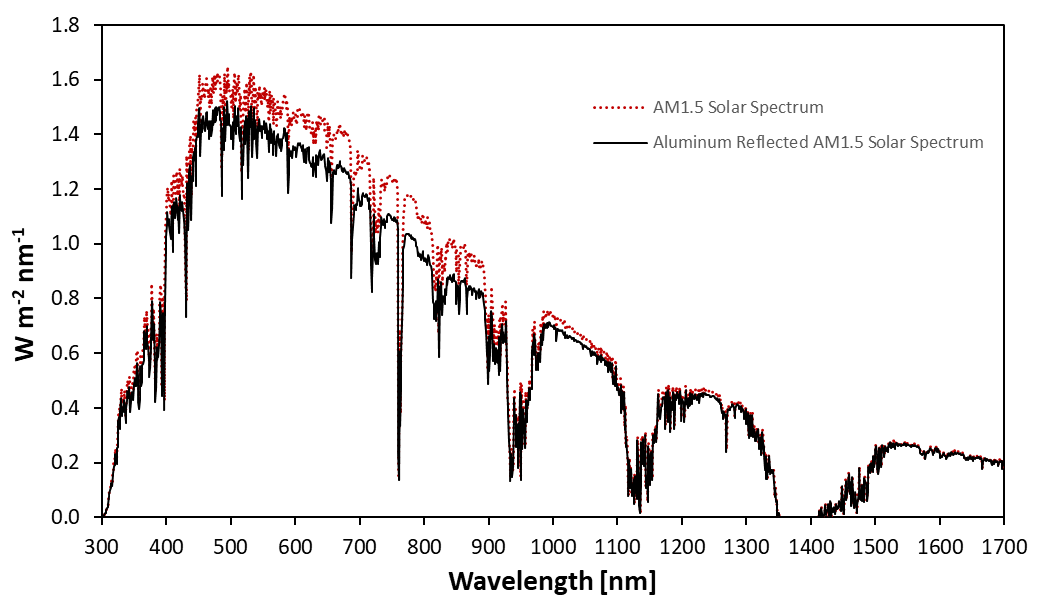
Figure 1. Spectral irradiance for sunlight and sunlight reflected from a specular aluminum reflector.
Earendil-1 is intended to be launched into a sun-synchronous, low earth orbit at an altitude of 625 km. This orbit will allow delivery of sunlight to the earth’s surface after local sunset or before local sunrise. This orbital geometry necessitates the reflector be positioned at an approximate 45° angle to the earth’s surface which reduces the area available for collection and redirection of sunlight.°
Accounting for this, the total luminous flux that reaches the ground is:

Similarly, the total radiant flux reaching the ground it

Dividing these flux values by the area of the illuminated spot on the ground yields an average irradiance of 10.46 mW/m2 and an average illuminance of 1.18 lux. This is a factor of 3.77 times greater than the illuminance of a full moon which is less than the factor of 5x claimed by Reflect Orbital. Variation in lux levels are expected across the illuminated area and Reflect Orbital’s claim of 5 times the level of moonlight may reflect this fact.
Photobiological Hazard Assessment
IEC 62471[13] includes many hazard categories including: UV Hazard, Blue Light Hazard, and Burn Hazard. The UV hazard function primarily deals with light below 320 nm which is essentially absent from the solar spectrum. Therefore, no formal photobiological UV hazard assessment was conducted. This analysis differs significantly from that of Laframboise and Chou as it considers the spectral content of light as opposed to the radiant energy. Given the low illuminance and irradiance levels, and small source size the relevant hazards for analysis are blue light and retinal thermal (burn hazard) which have emission limits with units of W m-2 sr-1.
IEC 62471 describes blue light hazard as “Potential for photochemically induced retinal injury resulting form radiation exposure at wavelengths primarily between 400 nm and 500 nm (see Figure 2). This damage mechanism dominates over the thermal damage mechanism for times exceeding 10 seconds.”[14] The threshold for thermal or burn damage is much higher due to the ability of heat to be carried away from the retina via conduction of convection via blood flow in the retina. In contrast, the photochemical damage from blue light exposure is localized to the region illuminated/irradiated portion of the retina.
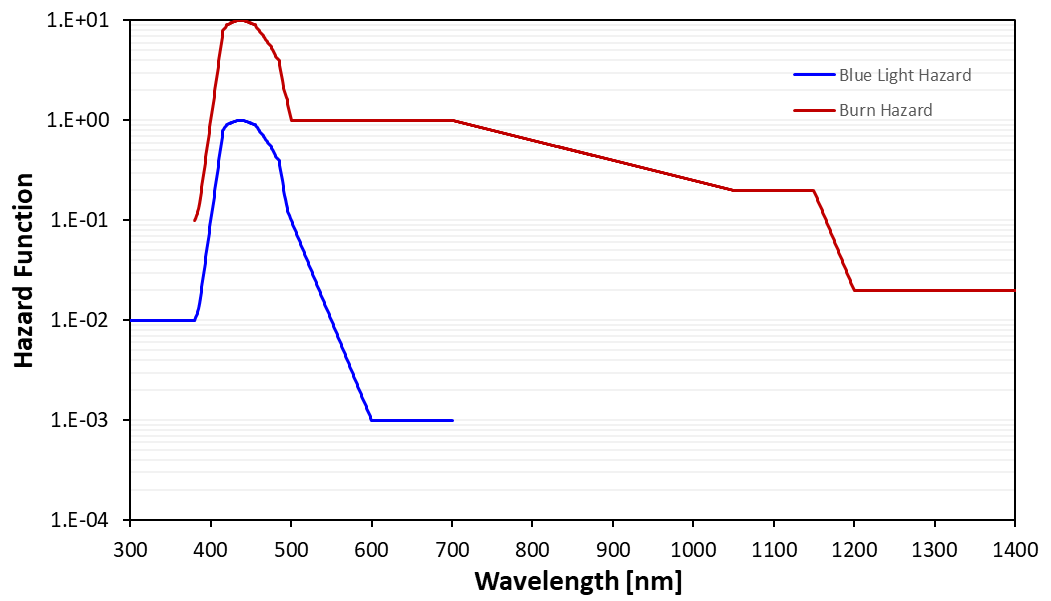
Figure 2. Blue Hazard and Burn Hazard Functions.
It is understood that light will be delivered from an OSR as it crosses the sky. The actual distance between an observer on the ground and the OSR will necessarily vary with angle. If it is assumed that light delivery requires that the OSR be with 60° of zenith, then for an OSR in a 625 km orbit, the distance between a ground observer and the OSR will vary between 625 and 722 km during a delivery transit. This variation in distance results in an approximate variation in subtended visual solid angle of about a factor of 1.88 times with the smallest visual angles corresponding to ±60° from zenith.
Because the solid angle subtended by a light source is a part of the blue hazard calculations, the calculations were conducted at the limits of solid angle which correspond to the OSR at zenith and at 60° from zenith.
IEC 62471 defines blue light hazard thresholds in units of W m-2 sr-1. These thresholds define different risk groups: RG1 is the lowest risk group and corresponds to products that do not pose a hazard due to normal behavior limits on exposure. RG2 represents moderate risk and corresponds to products that do not pose a hazard due to the aversion responses to very bright light sources or due to thermal discomfort. RG3 products are high risk products that may pose a hazard for momentary or brief exposure.
Using these definitions the threshold for an OSR at zenith and at 60° was calculated for each risk group in terms of ground level illuminance.
|
Risk Group |
Threshold W m-2 sr-1 |
Maximum Ground Illuminance |
|
|
Zenith |
60° |
||
| RG1 | 100 | 5.38 x 10⁻⁵ lux | 2.85 x 10⁻⁵ lux |
| RG2 | 10,000 | 5.38 x 10⁻³ lux | 2.85 x 10⁻³ lux |
| RG3 | 4,000,000 | 2.15 lux | 1.14 lux |
Table 1. Risk Group Threshold illuminance levels for an 18 m x 18 m OSR in a 625 km orbit.
The RG3 threshold for an OSR at zenith is at an illumination level of 2.15 lux or 6.72 times moonlight. This is the highest threshold and it is noted that an OSR at zenith has the lowest probability of being within the field of view of an observer at ground level.
Conversely, the RG3 threshold for an OSR at 60° is at an illumination level of 1.14 lux or 3.57 times that of moonlight. It is further noted that an OSR at 60° would be well within the field of view of a ground level observer provided they are facing in the direction of the OSR.
Discussion
At the angles most likely to be seen by an observer at ground level, an OSR would exceed the threshold for RG3 and would be classified as a hazardous light source. The intensity of the light source is sufficient to cause damage in a fraction of a second, less time than required for aversion or blink reflexes.
Even when providing illumination levels corresponding to those from a full moon (0.32 lux), an OSR would appear as a star with a visual magnitude of -13. As such, it would be easily visible in daylight and would be brighter than any historical supernova. The state illuminance levels of Earendil-1 (1.6 lux) correspond to a visual magnitude of -14.2.
Light sources classified as RG3 are of sufficient intensity to cause damage or injury in less than the 0.25 seconds required for an aversion or blink reflex. Because of this RG3 light sources require warning and safety interlocks to prevent injury to individuals in the exposure area. Such interlocks are not possible with an OSR which will illuminate an area with a diameter of about 5 km. This corresponds to over 6,000 acres which at suburban population densities would correspond to more than 10,000 households and potentially tens of thousands of residents.
A 5-mW laser pointer with a divergence of 0.5 mrad at a distance of 1 mile will illuminate an area about 1.61 meters across (2.03 m2). The irradiance at this distance would be about 2.46 mW/m2. This level of illuminance is considered a severe hazard for pilots and could result in significant legal penalties.
An OSR that provided illuminance equivalent to a full moon (0.32 lux) would result in an irradiance of 2.85 mW/m2, and thus present more of a hazard than a laser pointer. An OSR providing illuminance equivalent to 5x moonlight or 1.6 lux would result in an irradiance of 14.23 mW/m2, almost 6 times that of a 5-mW laser pointer at 1 mile. It follows that visual characteristics of Reflect Orbital’s Earendil-1 approximate those of a laser pointer at distances of less than half a mile, with the notable difference of color and location in the sky as opposed to being directed from the ground.
In the United States, per 18 USC §39A[15], it is a felony to aim a laser pointer at an aircraft. The penalties for this offense are a maximum fine of $250,000 and/or imprisonment for not more than 5 years. Canada has a similar law that uses a broader definition. Canadian law prohibits “projecting a bright light source” into airspace.[16]
Penalties in the UK are not restricted to incidents with aircraft. Under UK law, it is illegal to shine or direct a laser beam towards a vehicle with is moving or ready to move and the laser beam distracts, or is likely to dazzle or distract a person in control of the vehicle.[17] German law is similarly broad as it is illegal to interfere with the safety of traffic by railway, suspension railway, ship, air, or road.[18]
Conclusion
Delivery of light from an OSR has been shown to be a potential photobiological hazard that should require warnings and safety interlocks before delivery of light. However, as of yet, no mechanism has been identified that would even allow a warning for all persond within the target illumination zone of an OSR.
Visually, the appearance of an OSR is equivalent to a laser. Both are high intensity light sources that subtend an extremely small solid angle. Because of the known hazards of laser devices, legal penalties apply to individuals who knowingly point a laser at an aircraft or vehicle. The laws regarding safety of or interference with traffic in some countries are broad enough that light from an OSR directed toward the operator of an aircraft, train, ship, or vehicle would constitute a criminal offense.
- Bradley, Arthur and Peabody, Todd. “Ocular Hazards Associated with Eclipse Viewing.” The Hoosier Science Teacher. 2023; 46(2):17-24 doi:10.14434/thst.v4612.37201 ↑
- Atmaca LS, Idil A, Can D. “Early and late visual prognosis in solar retinopathy.” Graefes Arch Clin Exp Ophthalmol. 1995;233(12):801-804. doi:10.1007/BF00184094 ↑
- Mainster M. A. Solar eclipse safety. Ophthalmology. 1998;105(1):9-10. doi:10.1016/s0161-6420(98)90882-x ↑
- Thanos, S., Heiduschka, P. & Romann, I. Exposure to a solar eclipse causes neuronal death in the retina. Graefe’s Arch Clin Exp Ophthalmol 239, 794–800 (2001). https://doi.org/10.1007/s004170100362 ↑
- Canady, J. E., Allen, J. L., & United States National Aeronautics and Space Administration Scientific and Technical Information Branch. (1982). “Illumination from space with orbiting solar-reflector spacecraft.” National Aeronautics and Space Administration, Scientific and Technical Information Branch. https://api.semanticscholar.org/CorpusID:118470600 ↑
- Laframboise, James G. and Chou, Ralph. “Space Mirror Experiment: A Potential Threat to Human Eyes.” JRASC. 2000; 94 237-240. ↑
- ASTM G173-03 “Standard Tables for Reference Solar Spectral Irradiance: Direct Normal and Hemispheric on 37° Tilted Surface.” 2020, https://rredc.nrel.gol/solar//spectra/am1.5/ASTMG173/ASTMG173.html ↑
- Wu J, Seregard S, Algvere PV. Photochemical damage of the retina. Surv Ophthalmol. 2006; 51(5):461-481. doi:10.1016/j.survophthal.2006.06.009 ↑
- IEC 62471:2006 “Photobiological Safety of Lamps and Lamp Systems.” 2008 ↑
- Canady, J. E., Allen, J. L., & United States National Aeronautics and Space Administration Scientific and Technical Information Branch. (1982). “Illumination from space with orbiting solar-reflector spacecraft.” National Aeronautics and Space Administration, Scientific and Technical Information Branch. https://api.semanticscholar.org/CorpusID:118470600 ↑
- ASTM G173-03 “Standard Tables for Reference Solar Spectral Irradiance: Direct Normal and Hemispheric on 37° Tilted Surface.” 2020, https://rredc.nrel.gol/solar//spectra/am1.5/ASTMG173/ASTMG173.html ↑
- CRC Handbook of Chemistry and Physics. CRC Press, 1992. ↑
- ANSI/IES RP-27-20 Photobiological Safety for Lighting Systems includes the same hazard categories and calculation methods. It is mentioned here for completeness and the photobiological hazard under this standard would be the same as for IEC 62471. ↑
- IEC 62471:2006 “Photobiological Safety of Lamps and Lamp Systems.” 2008. p15 ↑
- https://www.law.cornell.edu/uscode/text/18/39A ↑
- Canadian Aviation Regulations 601.22 ↑
- Laser Misuse (Vehicles) Act 2018, Chapter 9 ↑
- German Criminal Code §315 ↑
0 Comments