
Technical Report: The Mathematics of Orbital Solar Reflectors
I. Executive Summary
At the time of their original submission to the FCC for launch approval, Reflect Orbital claimed they would be able to deliver illuminances up to 5x that of a full moon (1.6 lux). A previous technical report found Reflect Orbital’s Earandil-1 satellite posed a potential photobiological hazard at illuminance levels of ≥ 1.14 lux Reflect Orbital has now revised their claimed illuminance capabilities downwards to 0.1 lux, which slightly less than ⅓ that of a full moon. On paper, this lower illuminance level would obviate concerns about photobiological hazards. This revision brings a new concern as it requires a technology company to have made an error on the order of 1500% in calculations, that were used to secure funding and were critical to their business plan.
II. Introduction
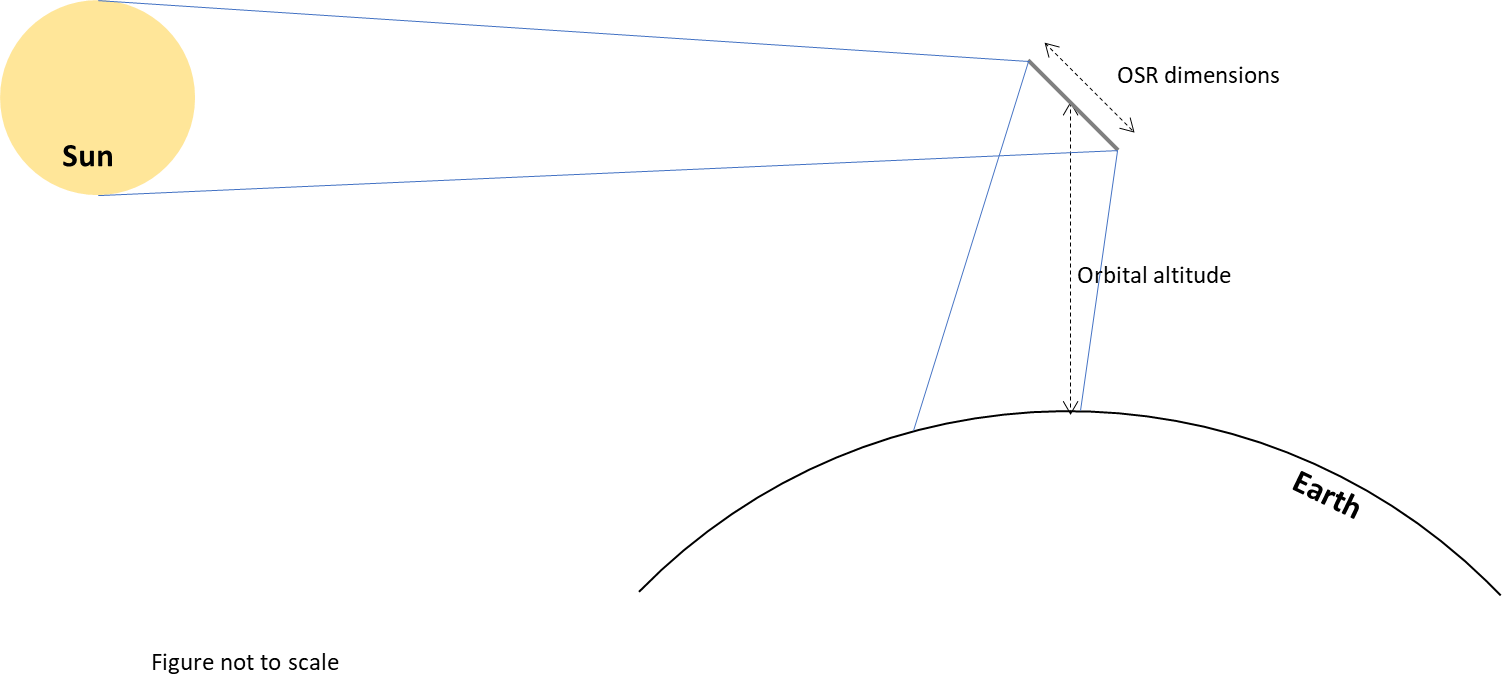
The mathematics of orbital solar reflectors (OSRs) are well known and do not require math beyond high school algebra and basic geometry.1 Critical OSR parameters include: orbital altitude, reflector size, reflectivity, and OSR angle relative to earth.
From this fundamental information, the average illuminance at ground level delivered by an OSR can be readily determined.
III. Reflect Orbital Public Information and Claims
Reflect Orbital has proposed to launch an OSR (Earendil-1) into a low earth, sun synchronous orbit for the express purpose of providing lighting on demand. The nominal solar reflector dimensions are 18 m x 18 m and the orbital altitude is specified to be 625 km.
Canady gave the diameter of the illuminated area on the ground as
Ds=0.0093d (1)
where Ds is the illuminate spot diameter on the ground
d = orbital altitude
Reflect Orbital currently2 states that light delivery will be “highly localized: and “precise” and show a graphic indicating a spot size of 5 km. The text is slighting contradictory as it indicates 5 km and up. Following Canady, the predicted spot size is 5.81 km (diameter).
Reflect Orbital also claims that their lighting service (2026 capabilities) will provide up to 0.1 lux3 which they claim is comparable to a full moon. No clear reference or support is provided, however it is known that the maximum illuminance provided by a full moon is 0.32 lux.4
This is a serious discrepancy as it is difficult to understand how a difference of more than a factor of 3x can be considered “comparable”.
IV. Delivered Light Analysis
The delivered illuminance of Earandil-1 can be estimated based on the solar spectrum, the reflectance spectrum of aluminum, the reflector area, angle of the reflector, and the illuminated spot size on the ground.
Reflect Orbital has proposed to use an aluminum-based reflector. It follows that the ground level spectral irradiance from Earendil-1 would be the product of the AM1.55 spectrum and the spectral reflectance of aluminum.6 The irradiance and illuminance of the AM1.5 solar spectrum equate to 1,000.36 W/m2 and 109,495.7 lux respectively.
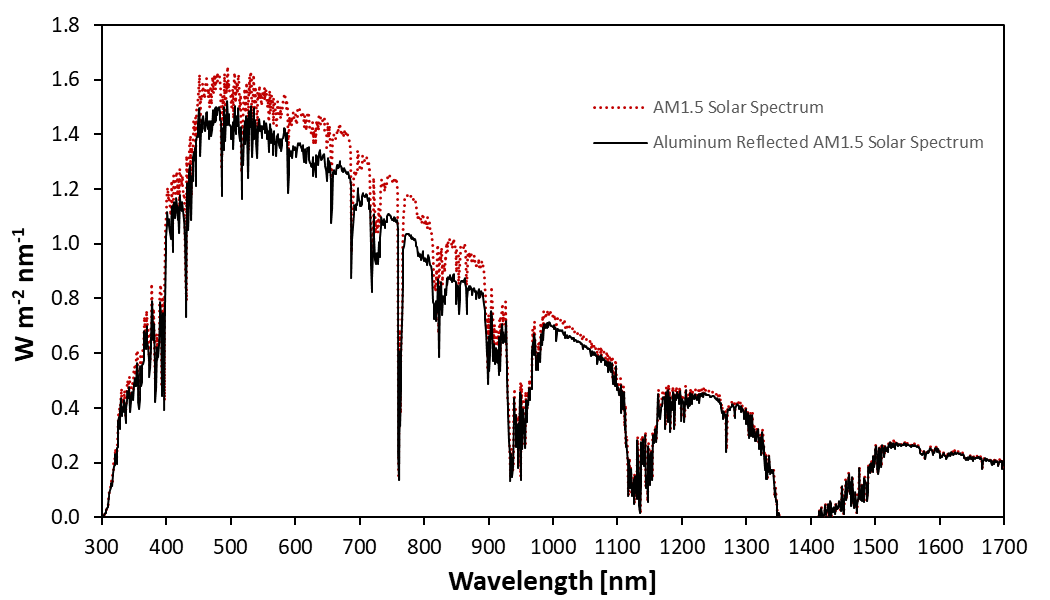
The luminous flux captured and redirected by Earndil-1 is determined by:
φ=φAM1.5AeffRavgcosθ (2)
where φAM1.5 = AM1.5 illuminance
Aeff = effective area of reflector
Ravg = average reflectivity
θ = angle of reflector relative to the sun
The AM1.5 illuminance is used here to account for atmospheric absorption. Illustrations and renderings of Earendil-1 make it clear that the reflective surface is less than that of the 18m x 18m dimensions of the satellite.
Given that Earendil-1 is intended to be in low earth orbit, the nominal angle of the reflector will be 45°, equation 2 can be rewritten as
φ=109,495.7 lmm2×182m21×Af1×Ravg1×cos(45°)1 (3)
φ=2.5086×10⁷AfRavg[lm] (4)
where Af = area fraction of reflector
The minimum illuminated area will correspond to the satellite at zenith and the illuminance can be calculated as the quotient of the luminous flux and the illuminated area. This yields the following equation for ground level illuminance:
E= φAill= 2.5086 × 10⁷AfRavg0.25πD2 [lux] (5)
E= 0.9462AfRavg [lux] (6)
where Aill = illuminated area on ground
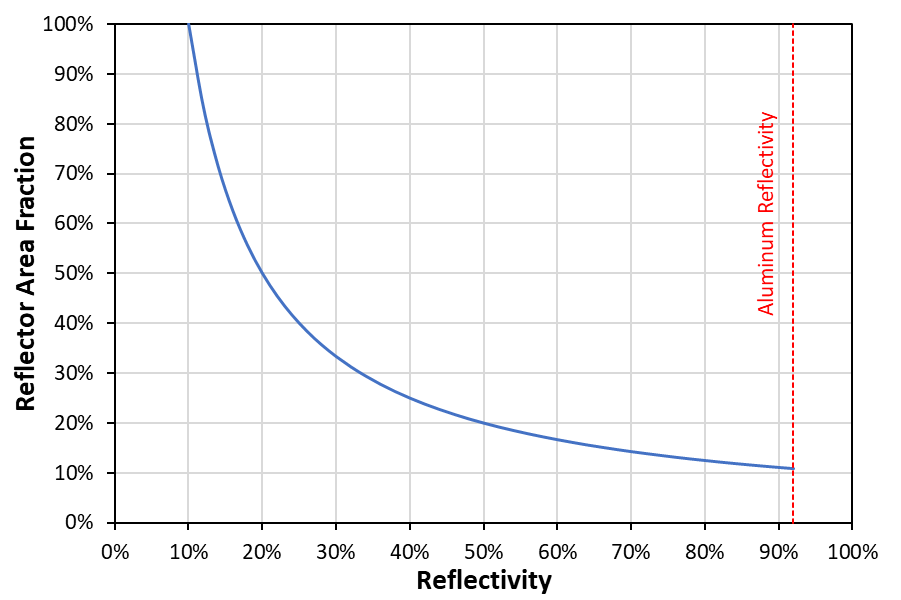
It follows that ground level illuminance at 0.1 lux would dictate that AfRavg = 0.1057. The parametric envelope of reflectivity vs area fraction is shown below.
V. Discussion
General engineering and design principles call for optimizing (maximizing) performance. This is especially true for satellite construction given the high launch costs. Published costs for SpaceX’s SmallSat Rideshare program are $350,000 for a 50 kg satellite and an additional $7,000/kg for mass in excess of 50 kg.7 At an estimated mass of 142 kg8, the launch cost for Reflect Orbital’s Earandil-1 is slightly less than $1,000,000.
An aluminumized reflectors have nominal reflectivities of about 92%9. It follows that the reflector on Earandil-1 would need an area fraction (% of reflective area) of slightly less than 11% in order to limit ground level illuminance to 0.1 lux.
This is difficult to understand why Reflect Orbital would design an OSR in which almost 90% of the potential reflective area was not used as a smaller reflector should naturally equate to a smaller and less massive satellite which would in turn reduce launch costs.
Alternatively, Reflect Orbital could use a less reflective material. Chromium has a nominal reflectivity of 50-60%, but that would still require the reflector on Earandil-1 would occupy no more than 80% of the 18m x 18m potential area. Here again, a much smaller satellite, would still suffice to deliver 0.1 lux.
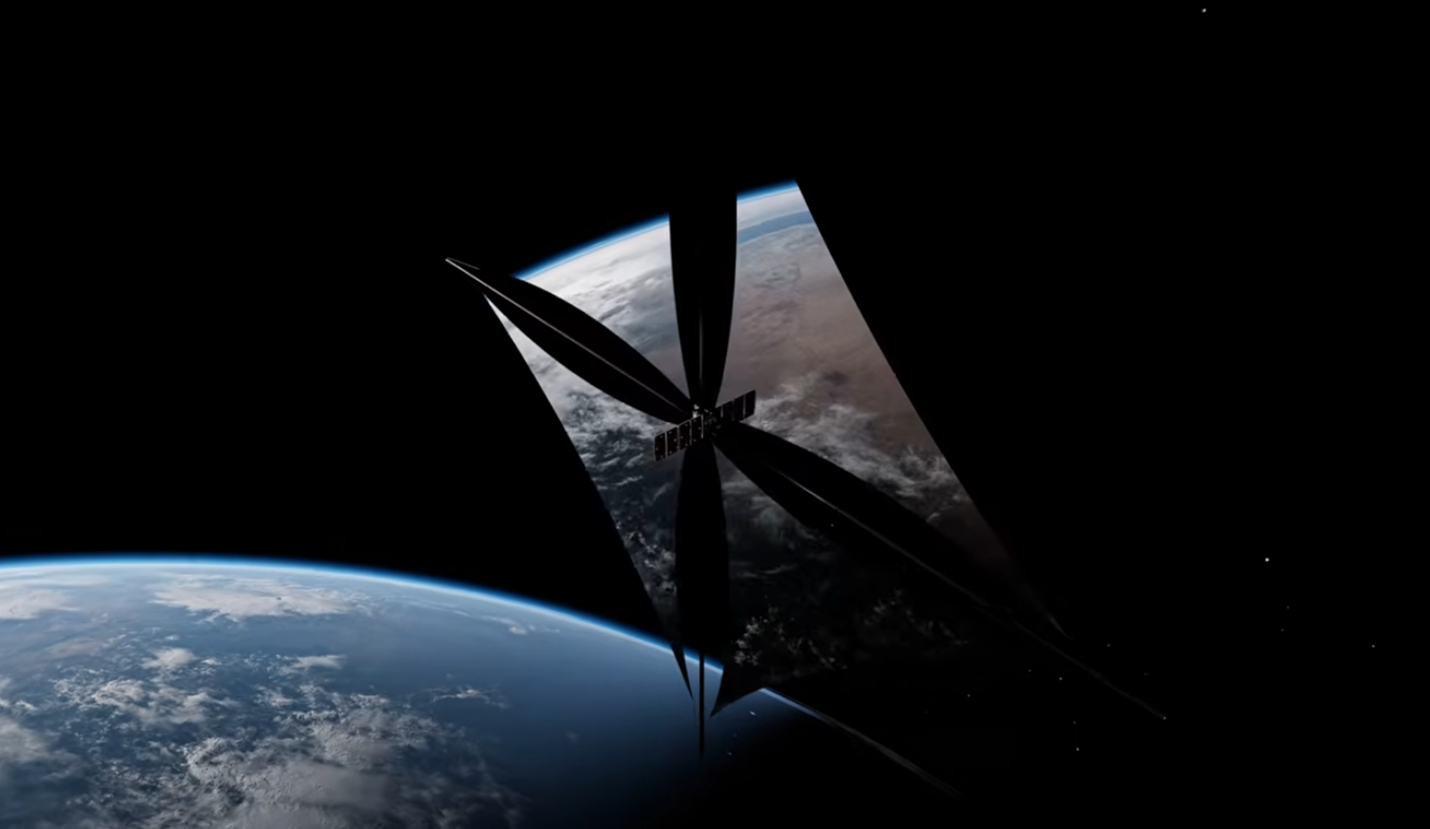
Renderings of Earandil-1 created by Reflect Orbital indicate a reflector area fraction of approximately 80%. At that coverage, the reflectivity required to limit ground level illuminance to 0.1 lux is about 12.5%. For comparison, fresh asphalt has a reflectivity of 5-10% and weathered asphalt has a reflectivity of 10-15%.11
Again, it is incomprehensible that any reasonable design would willingly choose a material for an OSR with such a low reflectivity when this would come at the cost of designing a much larger and more expensive to launch satellite.
A highly detailed analysis of the performance of OSRs was conducted by Celik et al.12 Celik reported that peak illuminance delivered by a 20m diameter OSR in a 400 km orbit to be 2 lux. The reflector area of Celik’s OSR is almost identical to the stated dimensions of Earandil-1. From equation 1 above, it follows that Celik’s OSR at an orbital altitude of 625 km would result in a maximum ground level illuminance of 0.82 lux.
In a previous technical report, the corneal irradiance of a 5 mW laser pointer at a distance of 1 mile was calculated to be 2.46 mW/m2. Reflect Orbital’s revised maximum illuminance claim of 0.1 lux would equate to corneal irradiance levels of about 0.91 mW/m2 or a factor of 2.7x below the corneal irradiance form a laser pointer.
Extrapolating from Celik, the more probable ground level illuminance from Earendil-1 is approximately 0.82 lux, more than 8x higher than Reflect Orbital’s current claim. At 0.82 lux, the corneal irradiance from Earendil-1 equates to 7.31 mW/m2 or 3x higher than a 5 mW laser pointer at a distance of 1 mile. As such, it remains highly likely that Earendil-1 will pose a significant risk to aircraft pilots and operators of other moving vehicles on land, rail, and water.
Conclusion
If accepted, Reflect Orbital’s recent reduction in predicted ground level illuminance from 5x that of a full moon to < ⅓ that of a full moon mean that Earandil-1 would likely not result in a photobiological hazard. However, rudimentary and more detailed analyses show that the dramatic reduction cannot be supported by any reasonable calculation.
The probable upper limit for ground level illuminance provided by Earendil-1 is approximately 0.82 lux and would correspond to a corneal irradiance of 7.31 mW/m2 which exceeds that of a 5 mW laser pointer at a distance of 1 mile.
References
- Canady, J. E., Allen, J. L., & United States National Aeronautics and Space Administration Scientific and Technical Information Branch. (1982). “Illumination from space with orbiting solar-reflector spacecraft.” National Aeronautics and Space Administration, Scientific and Technical Information Branch. https://api.semanticscholar.org/CorpusID:118470600
- Reflectorbital.com last visited 20 July 2026
- Ibid
- Kyba, Christopher C M, Mohar, Andrej, and Posch, Thomas “How Bright Is Moonlight.” Astronomy & Geophysics. 2017; 58, 1 31-32
- ASTM G173-03 “Standard Tables for Reference Solar Spectral Irradiance: Direct Normal and Hemispheric on 37° Tilted Surface.” 2020, https://rredc.nrel.gol/solar//spectra/am1.5/ASTMG173/ASTMG173.html
- CRC Handbook of Chemistry and Physics. CRC Press, 1992.
- https://www.spacex.com/rideshare last visited 20 July 2026
- https://satnews.com/2026/07/12/fcc-authorizes-radio-operations-for-reflect-orbitals-light-reflection-test-satellite/ last visited 20 July 2026
- CRC Handbook of Chemistry and Physics. CRC Press, 1992.
- https://www.youtube.com/watch?v=AGLRklIXrnA at 0:31, last visited 20 July 2026
- http://overlays.acpa.org/Downloads/RT/RT3.05.pdf last visited 20 July 2026
- Celik, Onur, Viale, Andrea, Oderinwale, Temitayo, Sulbhewar, Litesh, McInnes, Colin R, “Enhancing Terrestrial Solar Power Using Orbiting Solar Reflectors.” Acta Astronautica. 2022, 195 276-286
0 Comments